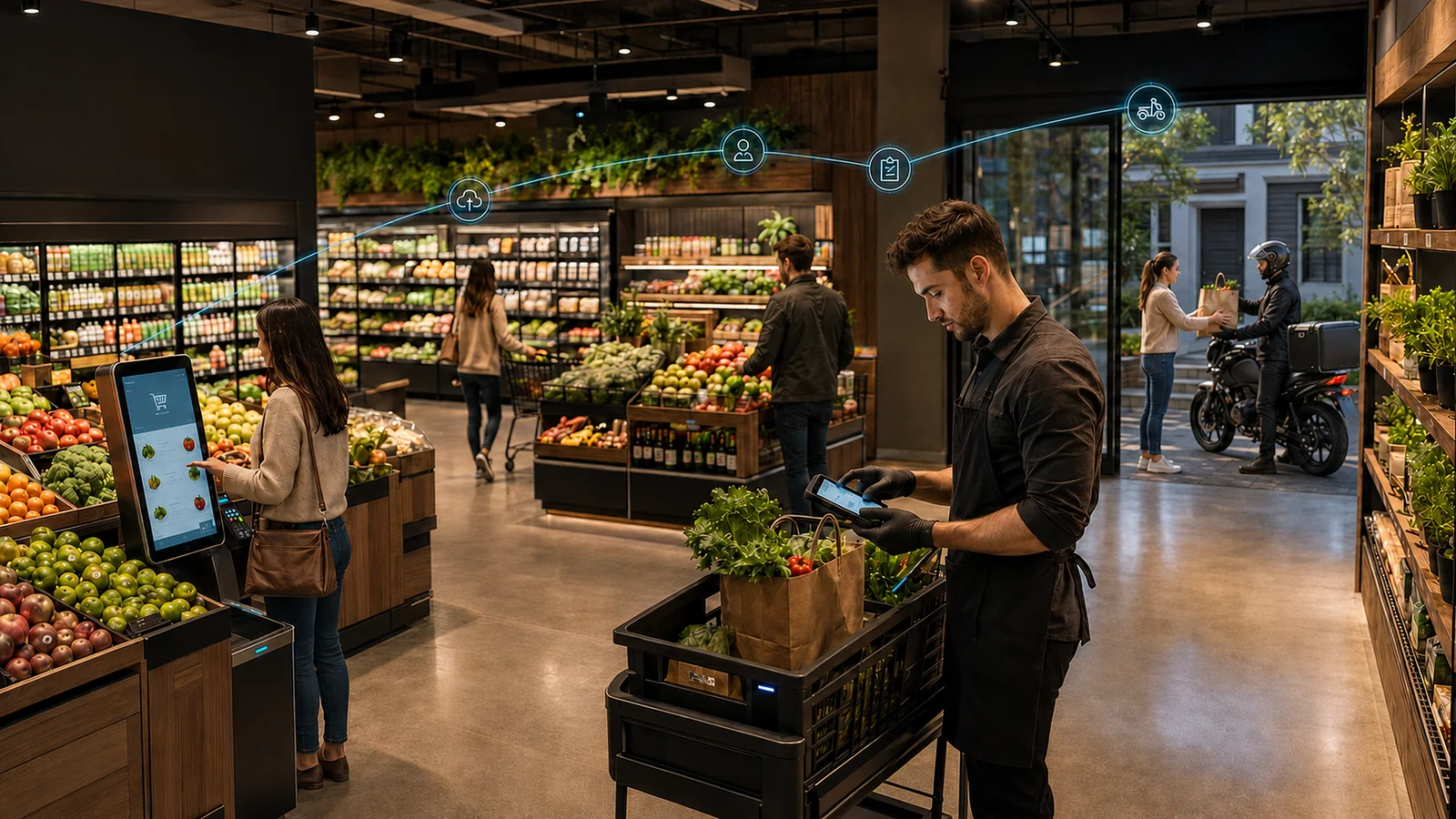
AI is no longer helping customers only find products. It is beginning to shop on their behalf.
Retail has always evolved around one question: how can shopping become easier?
First came ecommerce. Then mobile shopping, personalized recommendations, self-checkout, and omnichannel retail.
Now, another change is gaining attention: agentic commerce.
Imagine asking an AI assistant to plan five healthy dinners, stay within your weekly budget, avoid specific ingredients, and order everything for delivery before 6 p.m.
Instead of giving you a list of websites to visit, the assistant compares products, checks availability, builds the basket, and prepares the order.
You provide the intention. The AI handles much of the shopping journey.
This is where digital commerce is heading.
So, what is agentic commerce?
Agentic commerce is a shopping experience in which AI agents can perform tasks on behalf of customers.
A traditional recommendation engine might suggest a product based on previous purchases. An AI shopping agent can go further. It can understand a request, compare several options, consider the customer’s preferences, and help complete the transaction.
The difference is simple.
Today, customers use technology to shop.
With agentic commerce, technology begins shopping for them.
The concept is still developing, but its foundations are already taking shape. New commerce standards are making it possible for AI agents to access product information, compare options, interact with retail systems, and support transactions.
Agentic commerce is moving from an interesting idea to a real retail channel.
From searching to asking
Traditional online shopping begins with a search bar.
Customers enter a product name, browse the results, compare prices, open multiple pages, and eventually make a decision.
Agentic shopping begins with a conversation.
A customer might say:
“I need a durable school backpack under $60 that can arrive by Friday.”
Or:
“Build me a vegetarian grocery basket for four people, but do not include mushrooms.”
These are not simple product searches. They include preferences, budgets, deadlines, and personal context.
An AI shopping agent can interpret those details and narrow hundreds of options into a few relevant choices. It can reduce the time between wanting something and buying it.
For customers, that means less searching.
For retailers, it creates a new kind of digital shelf.
Why grocery retail is a natural fit
Grocery shopping is repetitive, time-consuming, and full of small decisions.
Customers regularly buy the same essentials. They work within budgets, follow dietary preferences, compare pack sizes, search for promotions, and decide whether substitutions are acceptable.
This makes grocery a natural environment for agentic commerce.
An AI assistant could remember that a customer prefers lactose-free milk, accepts another brand of pasta when the usual one is unavailable, and wants approval before replacing baby products.
It could also help plan meals, find suitable alternatives, and automatically rebuild frequent baskets.
But this convenience depends on reliable retail information.
If inventory is inaccurate, the basket may include unavailable items. If dietary attributes are missing, the recommendation may be unsuitable. If promotions are outdated, the final price may not match the customer’s expectations.
The intelligence of the shopping agent is only as useful as the retail data behind it.
A new visibility challenge for retailers
Retailers have spent years making their products attractive and easy to find on websites and apps.
Now, those products must also be understandable to AI.
An agent needs more than a good image and product name. It needs clear information about ingredients, sizes, variants, availability, delivery options, prices, promotions, and policies.
When that information is incomplete or inconsistent, the agent may not recommend the product at all.
AI-assisted shopping is already gaining momentum. Retail and payment platforms are developing ways for AI agents to move beyond product recommendations and support real transactions. While the channel remains young, the direction is clear: conversational interfaces are becoming a new point of product discovery and purchase.
Retailers should therefore treat product data as part of the customer experience, not simply as backend information.
Suppy your commerce for the age of AI agents
Preparing for agentic commerce does not mean replacing your website or launching an AI assistant overnight.
It begins with the foundations: accurate product data, real-time inventory, connected pricing, clear fulfillment rules, and a consistent experience across every channel.
Agentic commerce is not a separate technology project. It is the next extension of omnichannel retail, giving customers another way to discover, evaluate, and purchase products.
The interface may be changing, but the goal remains the same: make every shopping journey simpler, smarter, and more relevant.
Ready to build for the agentic shopper?
Agentic commerce is creating a new way for customers to discover, compare, and purchase products. Retailers that prepare today will be better positioned as AI-assisted shopping continues to grow.
Whether you need to connect your commerce channels, improve the digital customer journey, or prepare your retail experience for emerging technologies, Suppy can help you turn the opportunity into something practical.
Book a free consultancy session with Suppy and discover what agentic commerce could look like for your business.